Choosing Between a Piezo and a Magnetic Buzzer for Medical Alarms
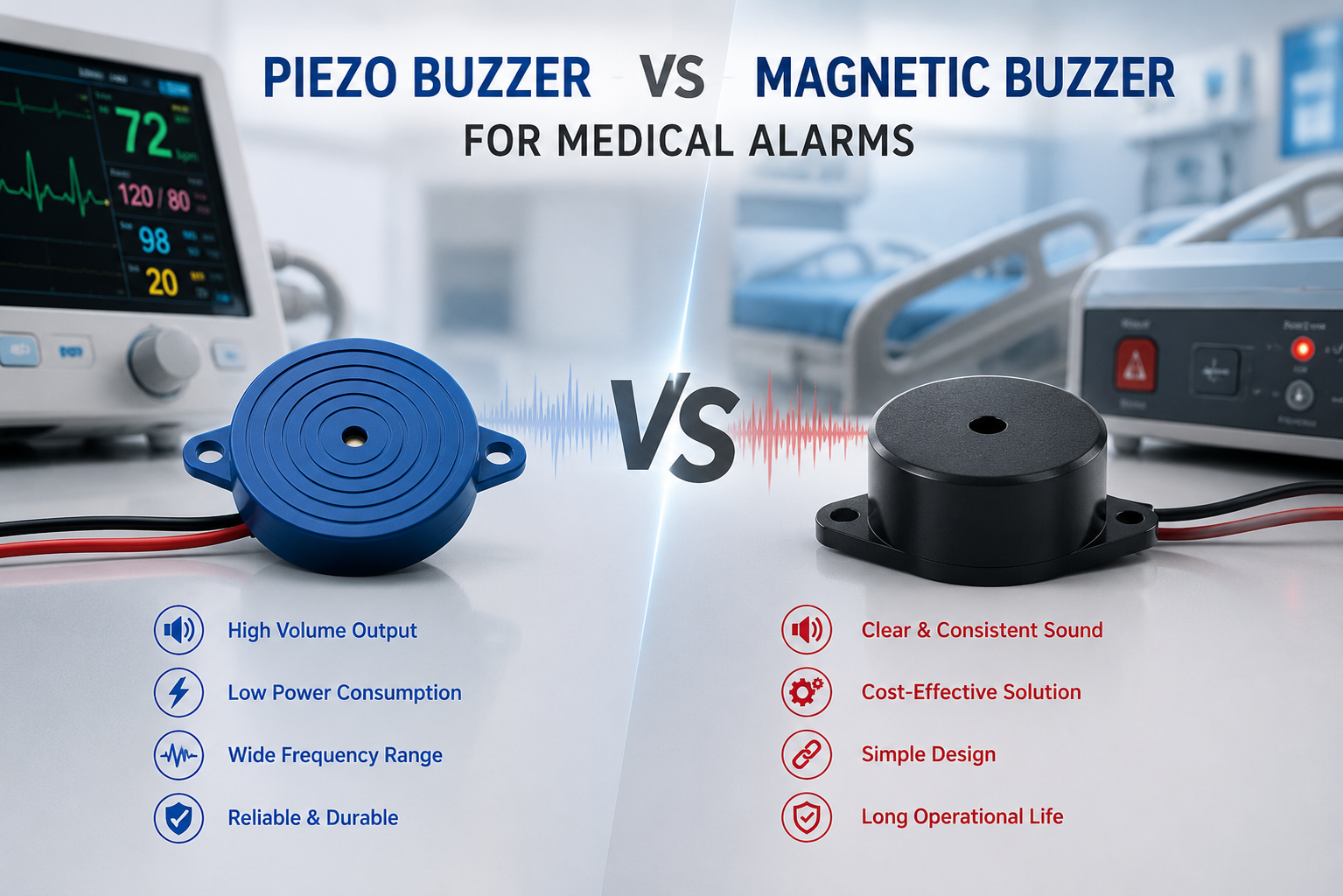
Quick Summary
- A piezo element flexes a ceramic disc when voltage is applied across it.
- Piezo transducers reach 85 to 100 dB at 10 cm without difficulty, and their resonant peak typically sits between 3.5 kHz and 4.5 kHz.
- External-drive piezo transducers need a drive circuit, and that circuit gives you full control of frequency and pattern.
Both technologies will make an alarm audible. Which one belongs in your design depends on the drive circuit you can afford, the sound pressure the standard demands, and the board space left once everything else is placed.
Medical alarm design carries a constraint consumer products do not. IEC 60601-1-8 sets out what an alarm must sound like, how loud it must be, and how it must behave over the life of the device. That standard, far more than component preference, drives the choice between a piezo and a magnetic buzzer.
Engineers often arrive at the decision late, once the enclosure is fixed and the power budget is spent. Taken up front, it is a short conversation. Taken late, it can mean a board revision.
How the two technologies differ
A piezo element flexes a ceramic disc when voltage is applied across it. There is no coil and no moving mass beyond the disc itself, so current draw stays low even at high sound pressure levels. A magnetic buzzer moves a ferromagnetic disc with an electromagnet, which produces a fuller tone at lower frequencies but draws considerably more current.
The practical consequence is that piezo transducers dominate battery-powered equipment, while magnetic buzzers are common where mains power is available and a less piercing tone is preferred.
For a battery-powered infusion pump, the current budget usually decides the question before the acoustics do.
Sound pressure and frequency
Piezo transducers reach 85 to 100 dB at 10 cm without difficulty, and their resonant peak typically sits between 3.5 kHz and 4.5 kHz. That is close to the range in which human hearing is most sensitive, and squarely inside the band IEC 60601-1-8 expects for high-priority alarms.
Magnetic buzzers usually resonate between 2.0 kHz and 2.7 kHz. They sound less shrill, which matters on wards where staff hear alarms for entire shifts, but reaching the same perceived loudness takes more power. On a device that must alarm continuously until acknowledged, that difference compounds.
Drive circuit and board space
External-drive piezo transducers need a drive circuit, and that circuit gives you full control of frequency and pattern. This is useful when the standard requires distinct tones for different alarm priorities. Self-drive buzzers contain their own oscillator and need only DC, which shortens development but fixes the tone at whatever the manufacturer chose.
On space: SMD piezo transducers start around 9 mm square and 1.7 mm tall. Magnetic buzzers in comparable output classes are typically 12 mm and up, and they are usually taller. On a handheld device that difference is rarely trivial.
A short checklist
- Confirm the sound pressure level the applicable standard requires, measured at the distance the standard specifies rather than at the distance on the datasheet.
- Check the current budget in alarm state, not idle state.
- Decide whether tone patterns must be programmable, which rules out self-drive parts.
- Verify the operating temperature range covers sterilisation or storage extremes.
- Request samples of both technologies and listen to them in the enclosure, not on the bench.
The last point matters more than engineers expect. An enclosure changes acoustic output substantially, and a part that measures well in free air can disappoint once it is mounted behind a grille. Budget a week for that comparison and it will not be the thing that delays the build.
Need help selecting a part?
Send us your requirements and we will suggest candidates from stock, with datasheets and samples.